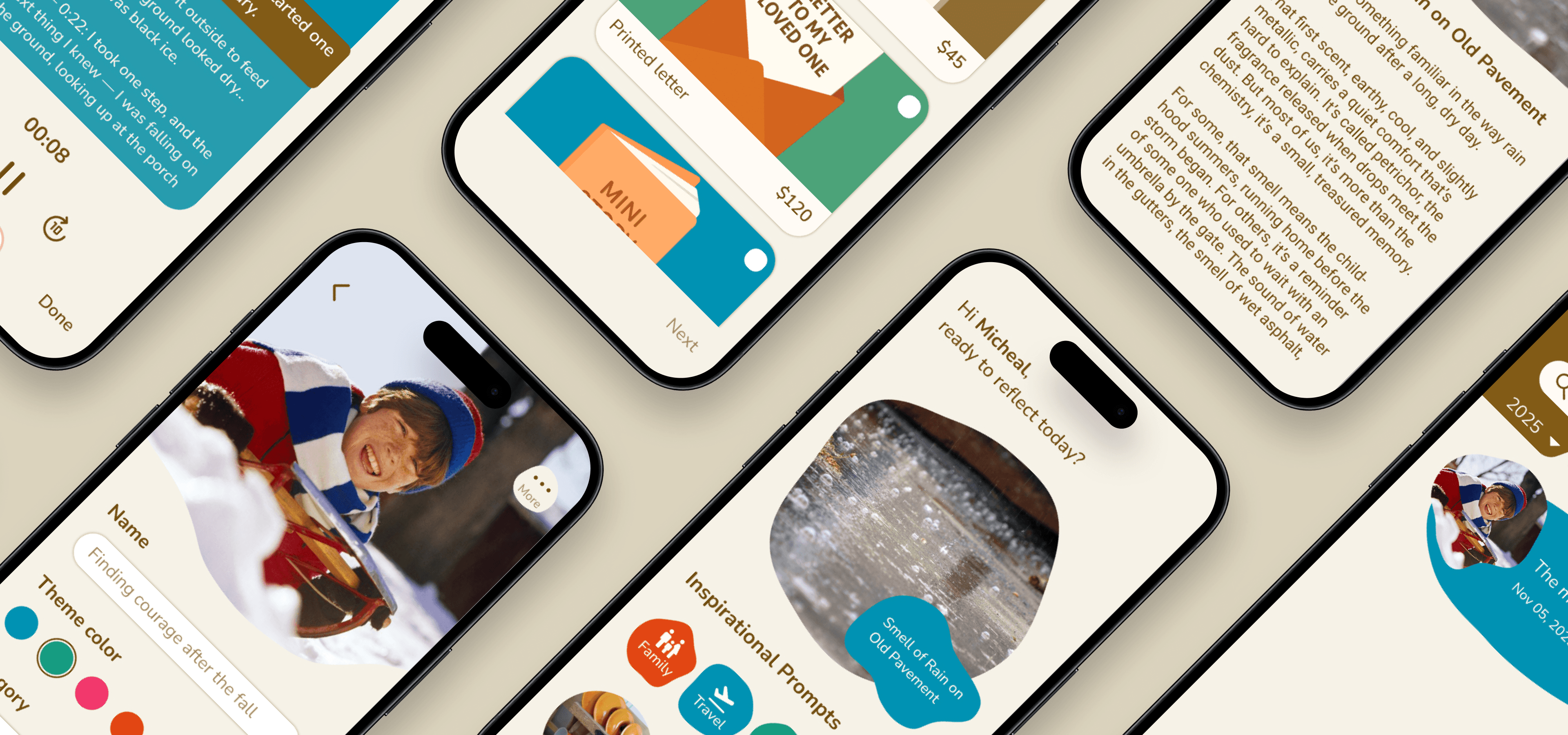
Memories Over Time

Memories Over Time

Memories Over Time

Memories Over Time

Memora is a app that helps older adults record voice memories and share them with loved ones.

Memora is a voice first app that helps older adults record memories and share them with loved ones.

Role:

UX / Product Design

Timeline:

14 weeks

Focus:

Voice based memory sharing

Position:

Emotional legacy

Role:

UX / Product Design

Timeline:

14 weeks

Focus:

Voice based memory sharing

Position:

Emotional legacy

Role:

UX / Product Design

Timeline:

14 weeks

Focus:

Voice based memory sharing

Position:

Emotional legacy

Role:

UX / Product Design

Focus:

Voice based memory sharing

Timeline:

14 weeks

Position:

Emotional legacy

The Problem

People care about preserving meaningful memories before loss, but struggle to begin and sustain the process. While older adults want to leave something behind, existing tools introduce effort and emotional resistance, preventing natural and low pressure memory capture.

Research

To understand emotional legacy and how memories are saved today, I ran interviews, reviewed research, and studied existing storytelling tools.

Exploratory Interviews

I interviewed people who had lost loved ones to understand what memories were kept and what was missing, focusing on how conversations and personal stories were preserved.

“Nothing really helps after they’re gone. You just learn to live with it.”

Through interviews, I found that grief is not something users expect products to solve. What remains is regret about conversations, stories, and moments that were never captured, shifting the focus to preserving memories before loss.

Secondary Research

To further understand why this gap exists, I reviewed research on older adults (60+) and shared memories across generations.

Before

69%

69%

older adults want to be remembered for shared memories

want to be remembered for shared memories

(Age Wave, 2019)

After

61%

61%

regret not keeping more memories of passed loved ones

(Statista, 2021)

Research shows that older adults often hesitate to share personal stories due to emotional barriers, such as fear of judgment, uncertainty about what to say, and not wanting to be a burden. (TellMeL, 2024)

Research shows that older adults often hesitate to share personal stories due to emotional barriers, such as fear of judgment, uncertainty about what to say, and not wanting to be a burden. (TellMeL, 2024)

Research shows that older adults often hesitate to share personal stories due to emotional barriers, such as fear of judgment, uncertainty about what to say, and not wanting to be a burden. (TellMeL, 2024)

Research shows that older adults often hesitate to share personal stories due to emotional barriers, such as fear of judgment, uncertainty about what to say, and not wanting to be a burden. (TellMeL, 2024)

Competitive Analysis

Most platforms push toward a set outcome, and general tools allow capture but lack emotional guidance. Memora focuses on meaning first, offering a private, low pressure space to reflect before sharing.
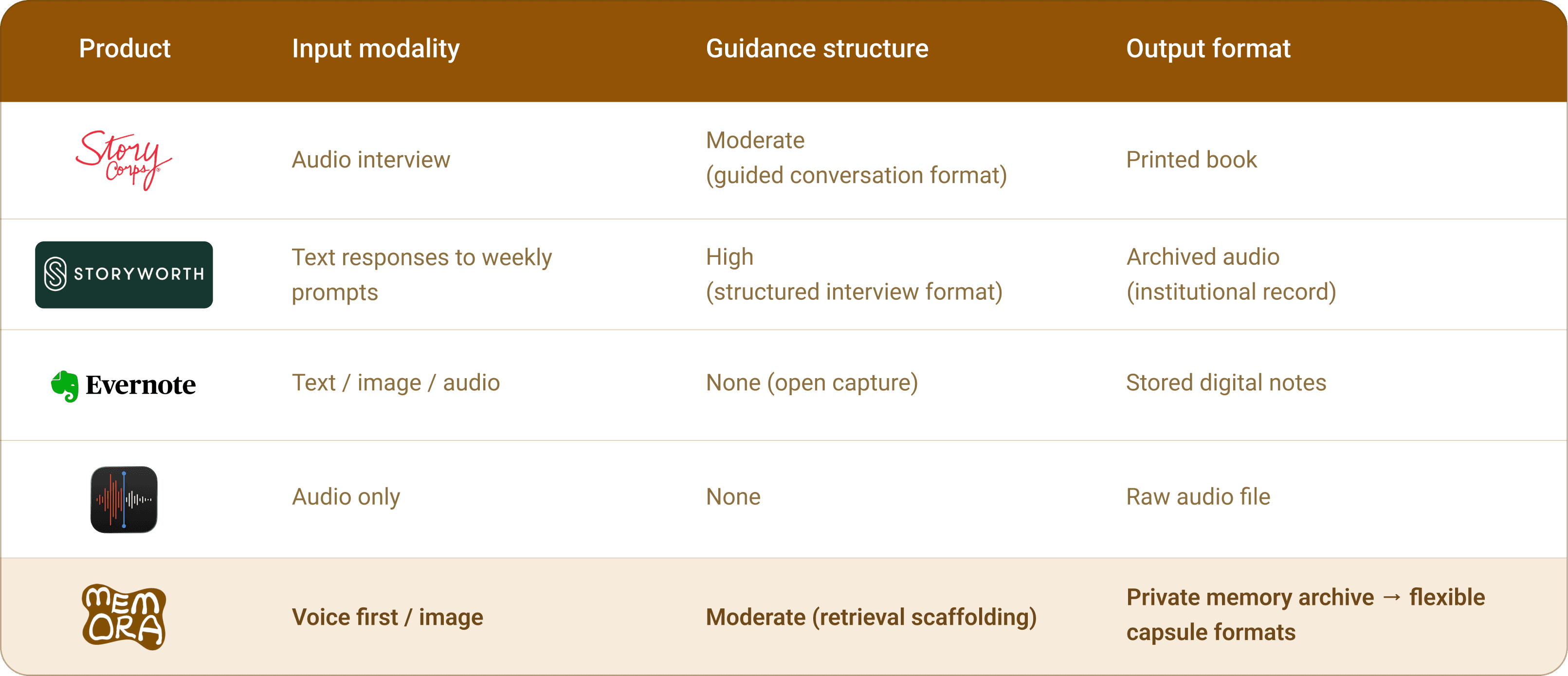
As a result, users may be able to record something, but they lack a comfortable and guided way to begin and sustain meaningful memory capture over time.

Key Insights from Research

Privacy comes before sharing

Users hesitate to share meaningful memories due to fear of judgment, uncertainty, and not wanting to be a burden.

Lack of structure makes starting hard

When asked to share something meaningful, users feel overwhelmed and struggle to know where to start.

Emotional connection matters most

What older adults want to pass on is not information, but personal memories, emotions, and values.

Reflection happens gradually over time

Meaningful memories emerge over time, requiring ongoing capture rather than one time storytelling.

Privacy comes before sharing

Users hesitate to share meaningful memories due to fear of judgment, uncertainty, and not wanting to be a burden.

Emotion matters most

What older adults want to pass on is not information, but personal memories, emotions, and values.

Lack of structure makes starting hard

When asked to share something meaningful, users feel overwhelmed and struggle to know where to start.

Reflection happens gradually over time

Meaningful memories emerge over time, requiring ongoing capture rather than one time storytelling.

Privacy comes before sharing

Users hesitate to share meaningful memories due to fear of judgment, uncertainty, and not wanting to be a burden.

Emotional connection matters most

What older adults want to pass on is not information, but personal memories, emotions, and values.

Lack of structure makes starting hard

When asked to share something meaningful, users feel overwhelmed and struggle to know where to start.

Reflection happens gradually over time

Meaningful memories emerge over time, requiring ongoing capture rather than one time storytelling.

How might we create an easy, gentle way for older adults to capture the memories and wisdom that matter most, before they are lost?

How might we create an easy, gentle way for older adults to capture the memories that matter most, before they are lost?

Design Principles

Designing for long term retention

Support ongoing memory collection over time, encouraging gradual reflection instead of one ime storytelling.

Privacy by default & user control

All memories remain private by default, with users fully controlling when, how, and with whom they are shared.

Cognitive load reduction

Reduce retrieval anxiety with guided prompts and voice first capture to lower the cognitive barrier to starting.

Designing for long term retention

Support ongoing memory collection over time, encouraging gradual reflection instead of one ime storytelling.

Privacy by default & user control

All memories remain private by default, with users fully controlling when, how, and with whom they are shared.

Cognitive load reduction

Reduce retrieval anxiety with guided prompts and voice first capture to lower the cognitive barrier to starting.

Designing for long term retention

Support ongoing memory collection over time, encouraging gradual reflection instead of one ime storytelling.

Cognitive load reduction

Reduce retrieval anxiety with guided prompts and voice first capture to lower the cognitive barrier to starting.

Privacy by default & user control

All memories remain private by default, with users fully controlling when, how, and with whom they are shared.

Design Solution Flow

Memora supports memory reflection as an ongoing and personal process, helping users begin easily, reflect privately, and share meaningfully when ready.

Recording

To reduce the pressure of not knowing what to say, the system uses voice recording with light prompts, so users can begin capturing memories in a natural and low pressure way.

Managing

To support the gradual nature of memory recall, the system provides a private space to revisit and build memories over time, so users can reflect without pressure before sharing.

Sharing

To reduce emotional resistance around sharing, the system reframes memories as capsules, so users can share them as meaningful and intentional acts when they are ready.

Testing & Iteration

I refined Memora through usability testing and flow updates, focusing on reducing emotional friction, improving clarity, and supporting low pressure memory capture for older adults.

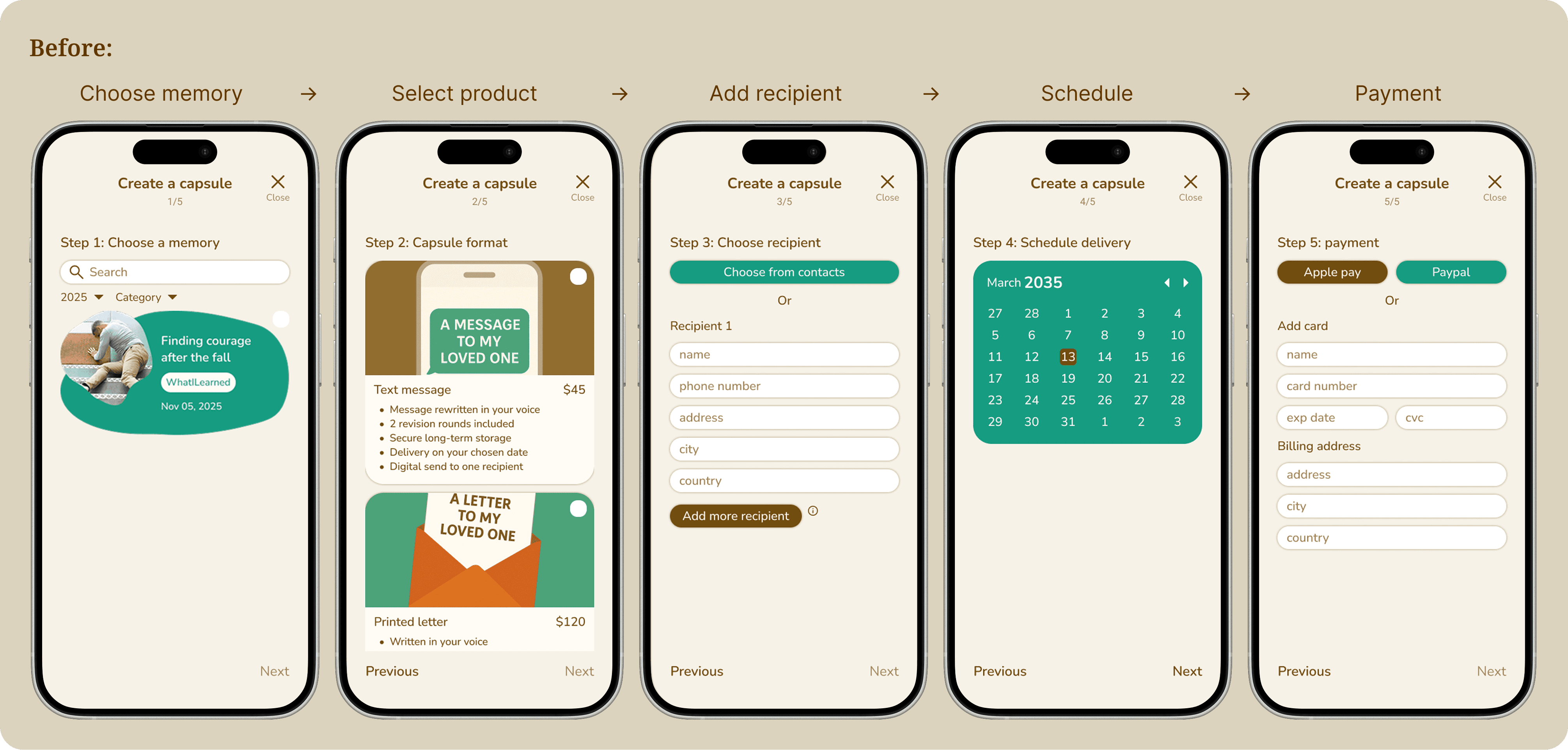
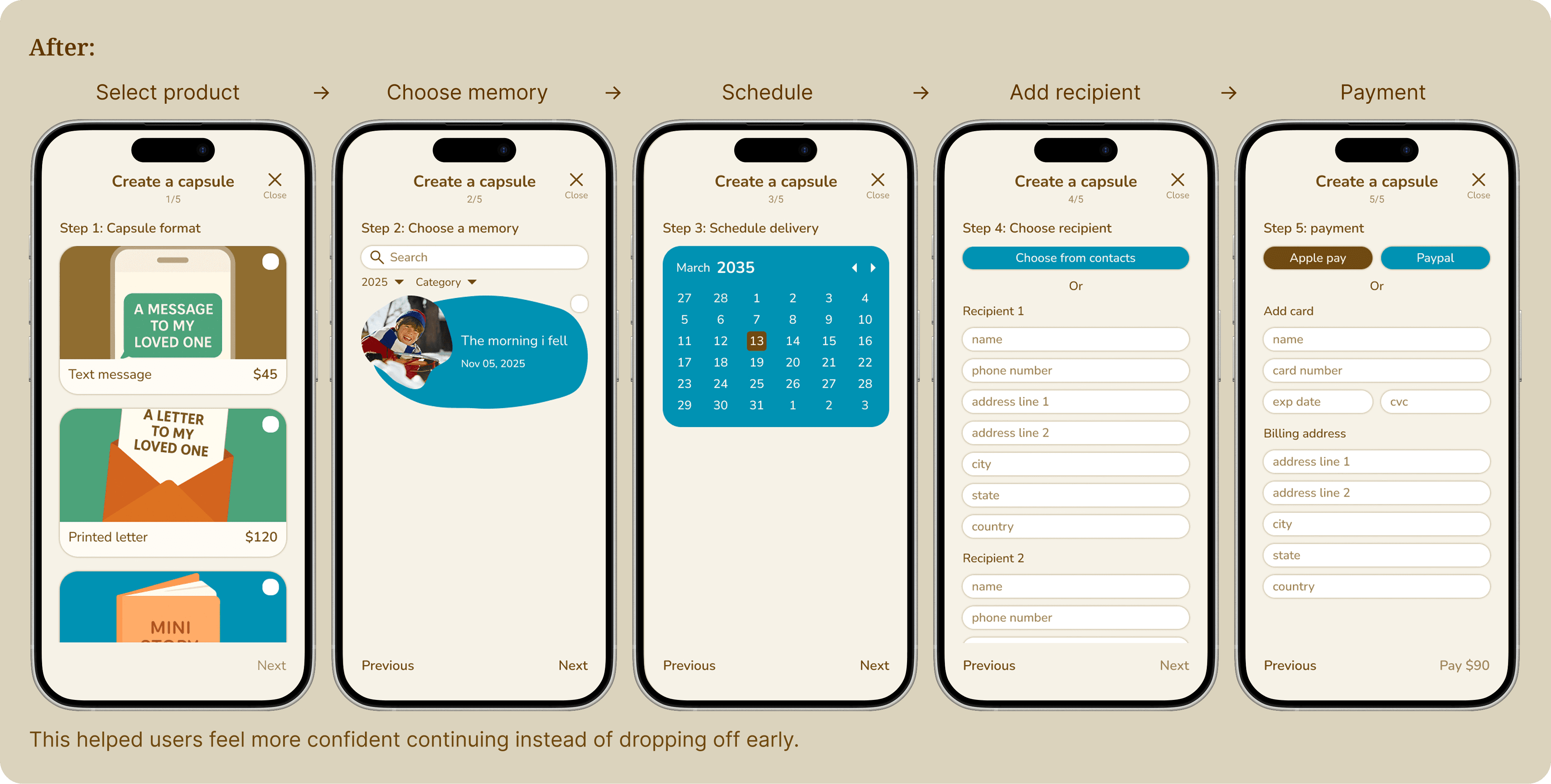
1. Reordering capsule creation steps to reduce drop off

Early testing showed that picking a memory before knowing the goal felt confusing. So I reordered the flow to start with product selection. This helped users understand the capsule first, then choose a memory, set a delivery date, add recipients, and complete payment.
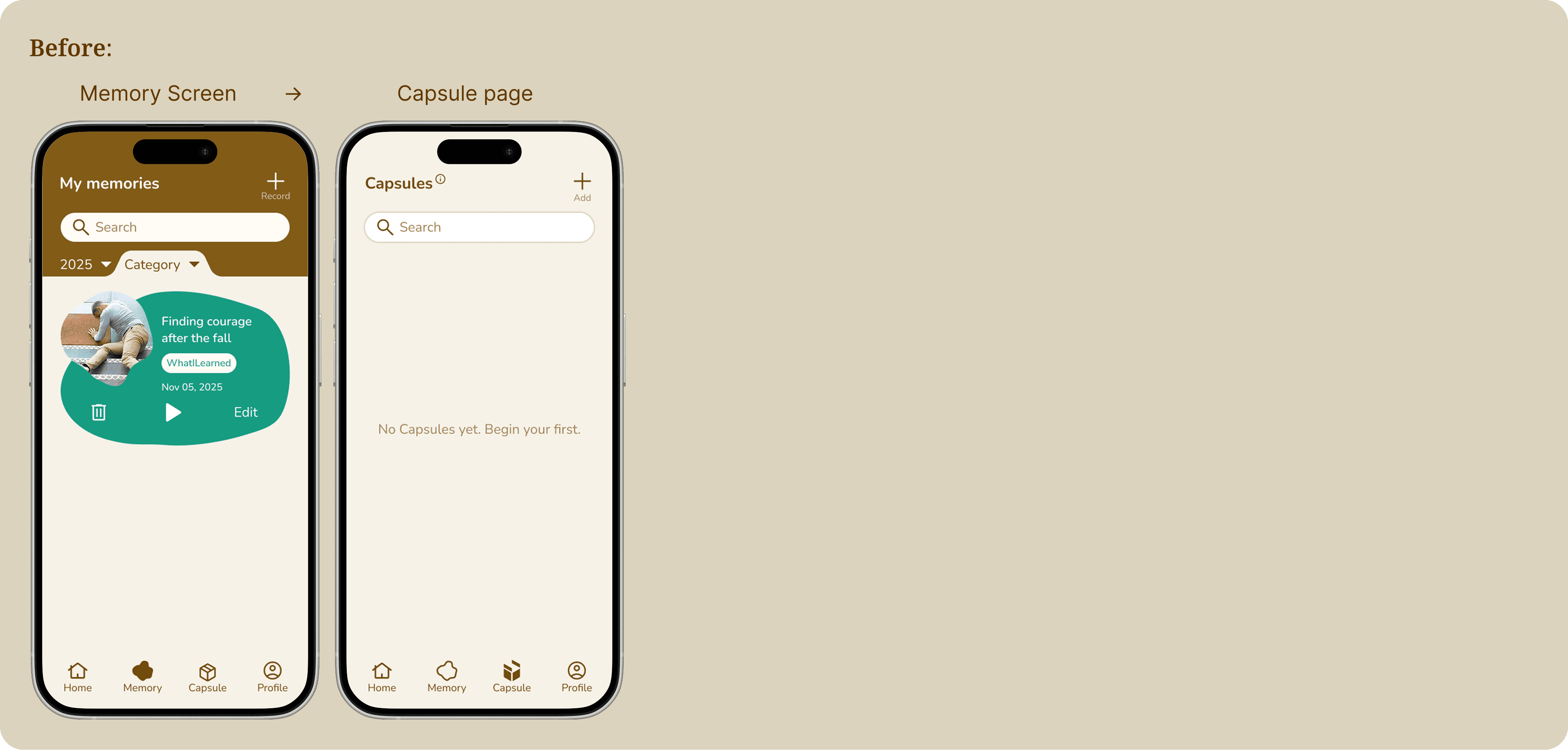
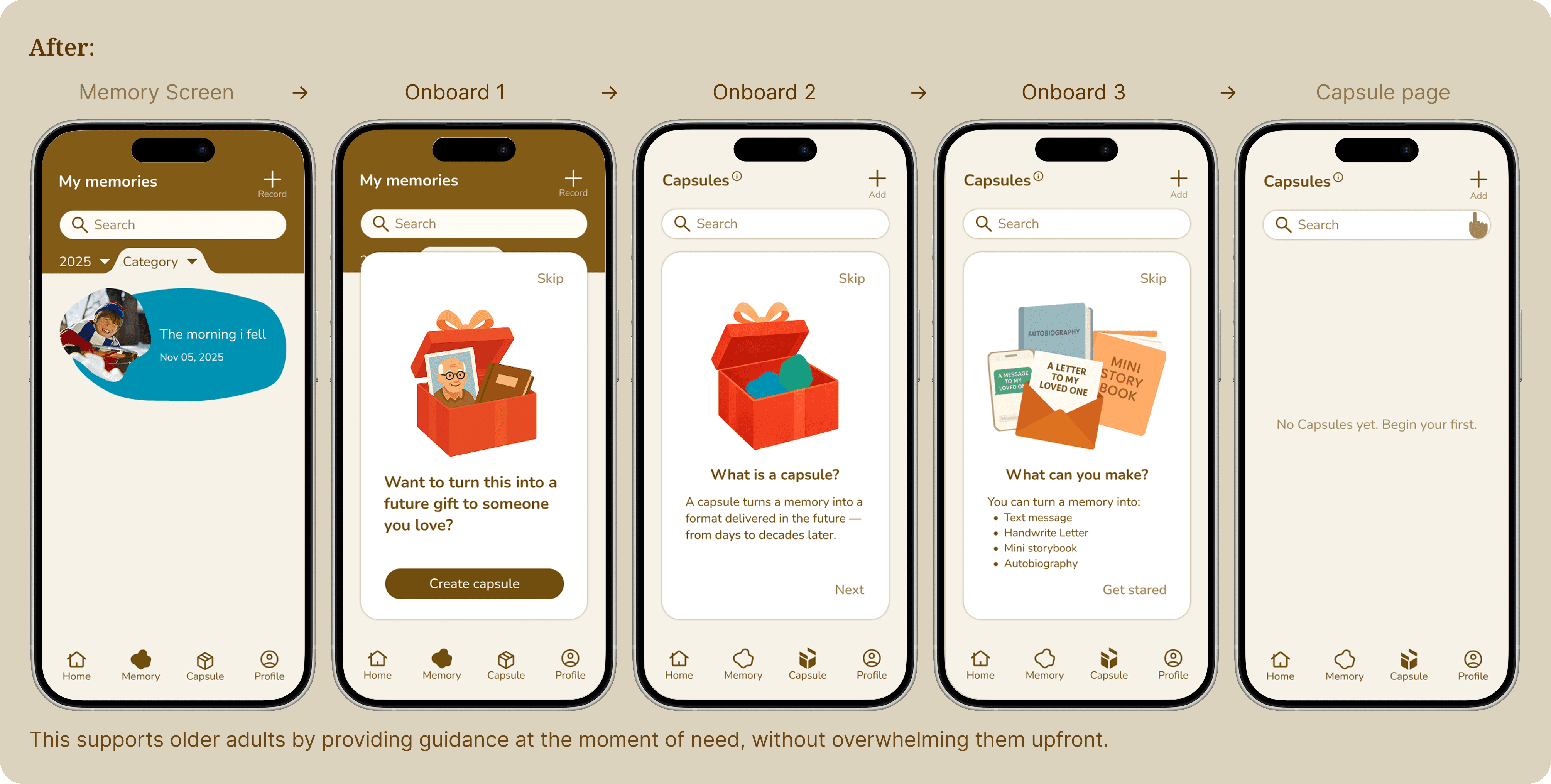
2. Adding contextual onboarding for empty states

After saving a memory, users often stopped and did not realize it could become a capsule. So I added an invite in the memory space, then onboarding on the Capsule page to explain capsules and formats. This guided users from reflection to sharing without breaking the flow.
Design Elements

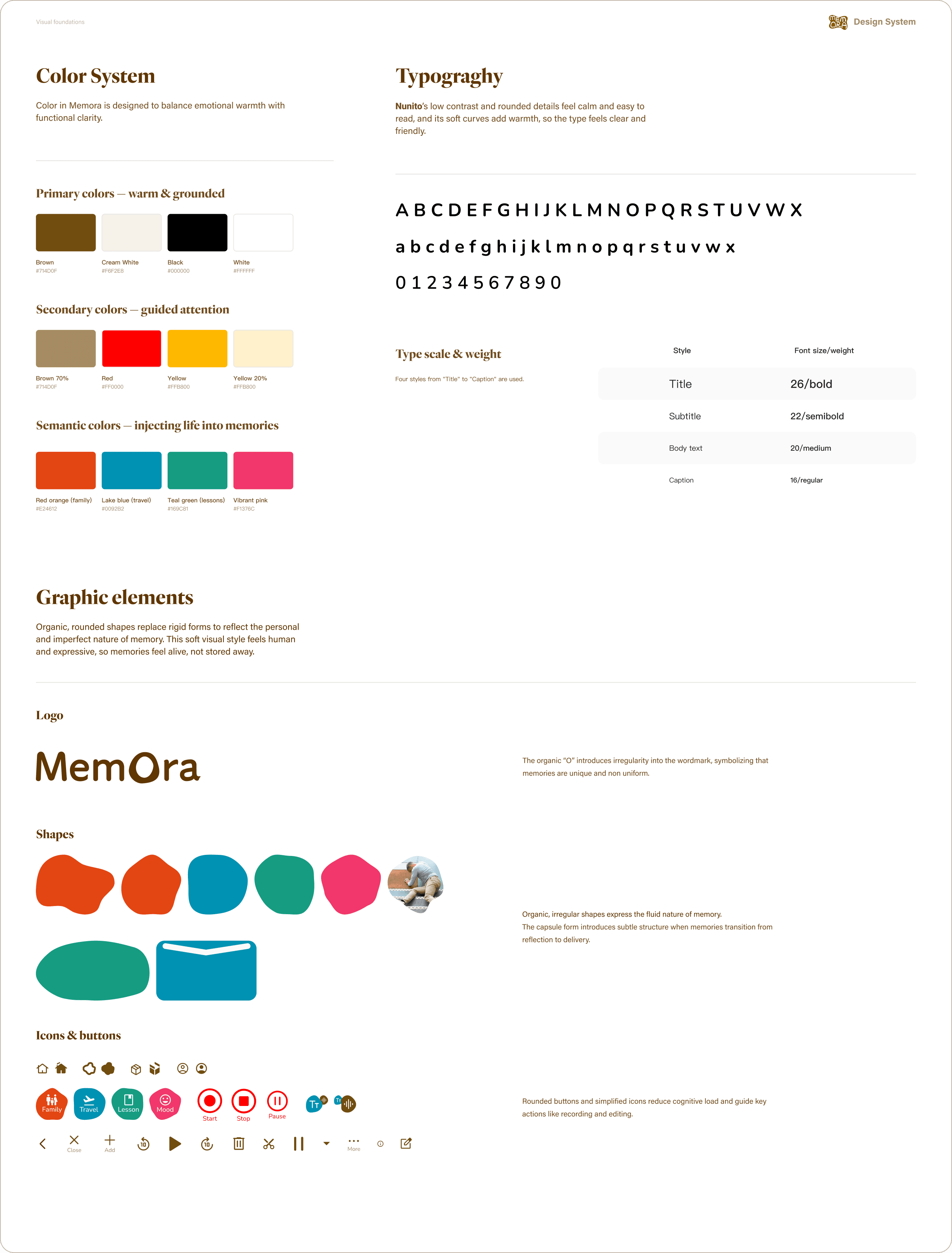
These design elements create a calm, warm, and friendly experience that lowers emotional barriers and keeps interactions clear and easy for older adults. Soft visuals, gentle structure, and small accents support reflection without pressure, so memories feel personal, alive, and easy to capture.
Reflection

Designing Memora pushed me to think beyond functional usability and focus on emotional resonance as a core design need. Working with legacy and memory meant managing cognitive load and making sure prompts and voice first interaction reduced retrieval anxiety instead of creating pressure. I also learned to align brand voice and interaction tone, keeping warmth, craft, and clarity consistent across visuals, content, and delivery formats. Most importantly, this project helped me move from designing single interactions to designing systems that support reflection and emotional continuity over time.

Next Steps

• Accessibility testing: Conduct usability testing with older adults who have different levels of digital skills, vision limits, or motor limits. Make sure text is readable, voice interaction is clear, and navigation is simple.

• Accessibility testing: Conduct usability testing with older adults who have different levels of digital skills, vision limits, or motor limits. Make sure text is readable, voice interaction is clear, and navigation is simple.

• Accessibility testing: Conduct usability testing with older adults who have different levels of digital skills, vision limits, or motor limits. Make sure text is readable, voice interaction is clear, and navigation is simple.

• Accessibility testing: Conduct usability testing with older adults who have different levels of digital skills, vision limits, or motor limits. Make sure text is readable, voice interaction is clear, and navigation is simple.

• AI assisted content support: Explore AI assisted features such as memory summarization, gentle follow up prompts, or organization support to reduce cognitive effort without replacing authentic voice.

• AI assisted content support: Explore AI assisted features such as memory summarization, gentle follow up prompts, or organization support to reduce cognitive effort without replacing authentic voice.

• AI assisted content support: Explore AI assisted features such as memory summarization, gentle follow up prompts, or organization support to reduce cognitive effort without replacing authentic voice.

• AI assisted content support: Explore AI assisted features such as memory summarization, gentle follow up prompts, or organization support to reduce cognitive effort without replacing authentic voice.

• Small circle social sharing: Prototype a limited memory sharing model for close family members to create a light social loop while maintaining privacy and emotional safety.

• Small circle social sharing: Prototype a limited memory sharing model for close family members to create a light social loop while maintaining privacy and emotional safety.

• Small circle social sharing: Prototype a limited memory sharing model for close family members to create a light social loop while maintaining privacy and emotional safety.

• Small circle social sharing: Prototype a limited memory sharing model for close family members to create a light social loop while maintaining privacy and emotional safety.

• Expanding digital delivery formats: Test more digital capsule formats beyond physical ones, like scheduled audio releases or private digital archives.

• Expanding digital delivery formats: Test more digital capsule formats beyond physical ones, like scheduled audio releases or private digital archives.

• Expanding digital delivery formats: Test more digital capsule formats beyond physical ones, like scheduled audio releases or private digital archives.

• Expanding digital delivery formats: Test more digital capsule formats beyond physical ones, like scheduled audio releases or private digital archives.

Create a free website with Framer, the website builder loved by startups, designers and agencies.